Hook-lift containers: types, sizes, and how to choose the right one
A larger container is not always a better choice. A hook-lift container should be chosen by material, load, and transport system — not by cubic metres alone.
A larger container is not always a better choice.
With hook-lift containers, a few extra cubic metres can help with cardboard and plastic — and be completely wasted on concrete, excavated soil, or metal scrap.
The reason?
One cubic metre of scrap and one cubic metre of cardboard have radically different weights.
That is why the right hook-lift container is not chosen by size alone. It is chosen according to the material, the load, the way you work, and the transport system.
What is a hook-lift container?
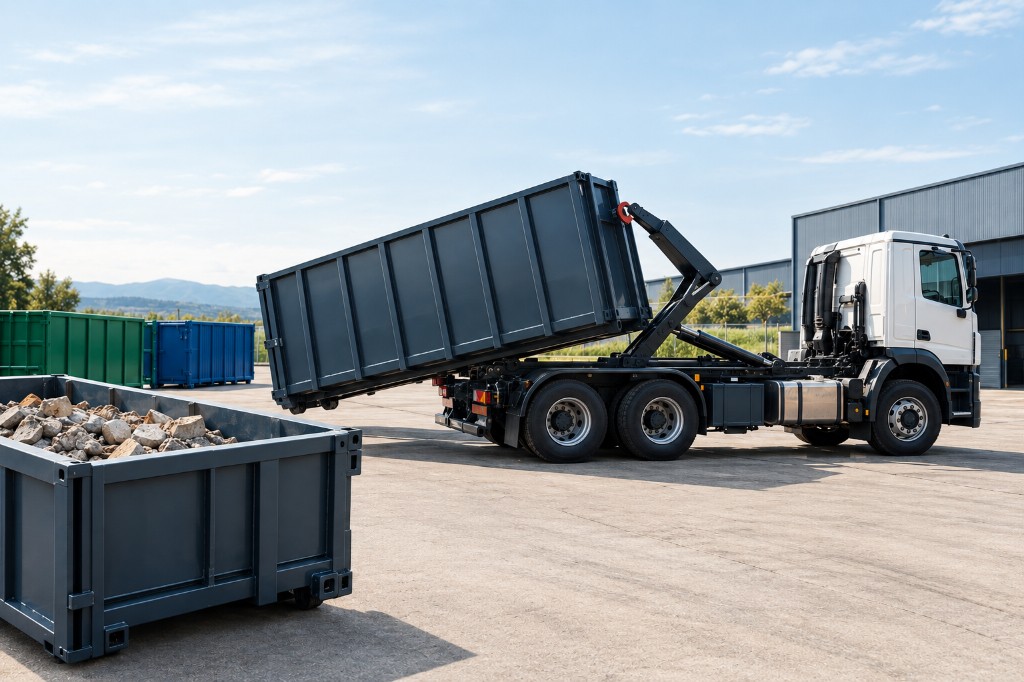
A hook-lift container (often called a multilift container) is a demountable steel skip that a specialised truck loads and unloads with a hook-lift system.
The practical advantage is simple: one truck can serve many containers.
While one container is being filled on site, another can already be on the road or being emptied.
That is why hook-lift systems are widely used in construction, recycling, industry, logistics, agriculture, and waste management. On building sites this sits alongside how construction waste is transported.
Did you know a larger container can carry less?
It sounds illogical, but it is entirely possible.
Imagine a large container loaded with concrete.
The maximum permitted weight of the vehicle combination can be reached long before the container is full.
In that case you are hauling air.
For heavy materials such as concrete, stone, excavated soil, and metal scrap, a lower, structurally reinforced container is often the more sensible choice.
For cardboard, plastic, timber, and packaging the logic is reversed — extra volume can reduce the number of transport runs.
What size should you choose?
Hook-lift containers can be built in different sizes and configurations for the specific job.
In practice, the choice should start with four questions:
- What will you transport?
- How much does the material weigh?
- What volume do you generate?
- Which hook-lift truck will you work with?
Only then does it make sense to talk about cubic metres.
Not sure what size you need? You do not have to define every technical parameter yourself.
Contact the TETRAX team, tell us what material you will move and which system you use, and we will propose a suitable configuration and a custom quote.
Open or closed?
Open hook-lift containers work well for construction materials, scrap, timber, and bulk loads, especially when loading is done from above with an excavator or a front loader.
Closed containers are the better fit when the load needs weather protection, or when you need to limit spillage and access to the contents.
There is another detail that is often missed.
Steel thickness should not simply be “as much as possible”
More steel means a stronger structure — but it also means a heavier empty container.
Every extra kilogram of tare weight reduces the payload you can legally carry.
A good structure is not simply heavy. It is reinforced where the load actually demands it.
With scrap, for example, the floor and certain wall zones take far more mechanical punishment than they would when hauling cardboard.
The intended use should determine the construction.
Three mistakes that can make a container more expensive
1. “I want the biggest one.”
Extra volume has no value if the maximum permitted weight is reached before the container is full.
2. “We will use it for everything.”
A container for cardboard and a container for scrap have different optimal designs.
3. “Let’s take the cheapest.”
With industrial equipment, the more important question is not only what the container costs today, but how many working cycles it will last.
The difference between a sound structure and the wrong one shows up not at delivery, but after months of daily use.
So what does a hook-lift container cost?
This is one of the most common questions — and there is no single universal price.
The cost depends on size, steel, thickness, reinforcement, doors, equipment, coating, and quantity.
Two containers with the same volume can have different prices because they are built for completely different loads.
That is why at TETRAX we look at the actual application before we propose a configuration.
Standard, or built for your operation?
Sometimes a standard container is entirely enough.
But when the material is specific, space is tight, loading is done in a particular way, the work is intensive, or the dimensions are non-standard, custom manufacturing can be the better solution.
TETRAX designs and manufactures steel containers to the client’s requirements — from size and structure through opening method, reinforcement, and extra equipment.
Looking for a hook-lift container?
Send us:
- what material you will transport;
- the approximate volume you need;
- the truck or hook-lift system you work with;
- how many containers you need.
We will help you define the right size and construction.
Contact TETRAX for a consultation and a custom quote to manufacture hook-lift containers.
Because the right question is not “How many cubic metres should I buy?”, but “Which container will do my job best?”