How does a silo for concrete and building mixes work? Design, functions, and advantages
How are dozens of tonnes of cement stored without the material getting damp, scattering, or interrupting production?
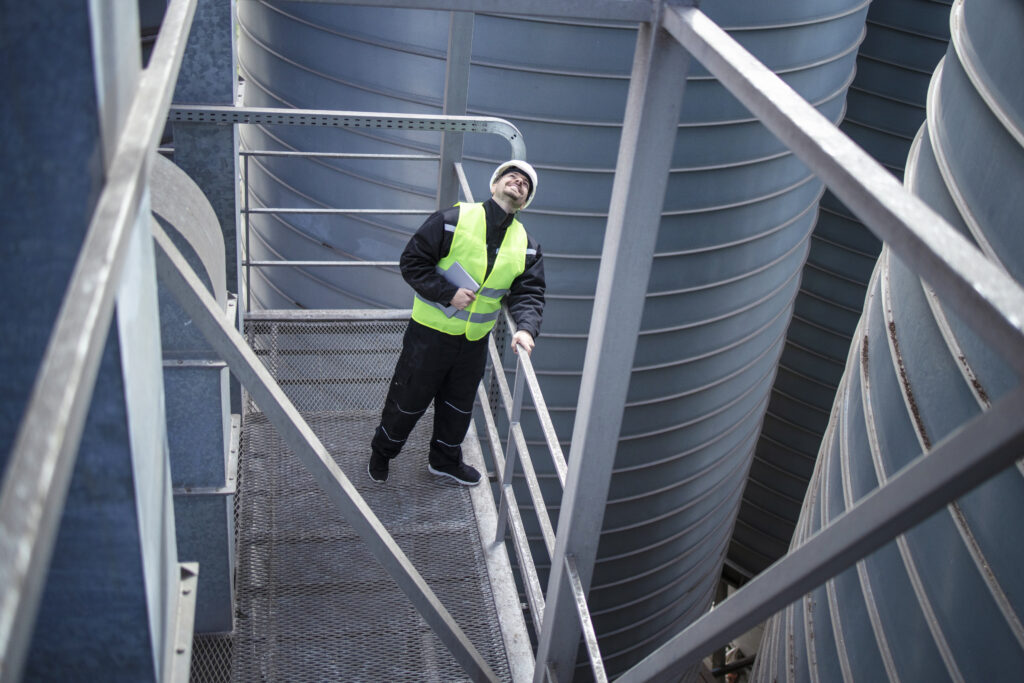
In the production of concrete, building mixes, and other materials, reliable raw-material storage is essential.
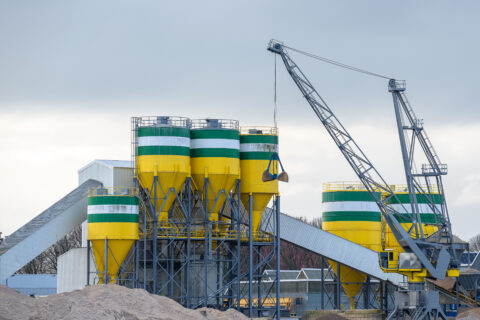
One of the main elements in that system is the silo for cement and dry building materials.
Although it may look like an ordinary metal tank, a modern silo is a technical facility that can include systems for filling, filtration, measurement, and controlled feeding.
Why is cement stored in a silo?
Cement is a fine powder that reacts with water and is sensitive to moisture.
With unsuitable storage it can form lumps, lose some of its working properties, and create problems when feeding production equipment.
A silo allows storage in a closed system that limits contact with atmospheric moisture and reduces material scatter.
How does the system work — step by step?
Stage 1. Filling the material
Cement is usually delivered by a specialised cement tanker.
Through a pneumatic system the material is conveyed by pipeline to the top of the silo.
Stage 2. Air filtration
During pneumatic filling, air enters the silo together with the material.
A specialised filter separates dust particles from the outgoing air, and suitable safety devices limit the risk of a dangerous pressure rise.
Stage 3. Storage
The material accumulates in the main volume of the silo.
In some systems sensors monitor the fill level and pass information to the operator.
Stage 4. Discharge
In the lower part of the silo the material is directed to an outlet.
Depending on the design, aeration devices, screw conveyors, or other mechanisms may be used to support the flow.
Stage 5. Dosing and production
Cement is fed to a dosing system that measures the quantity required for the recipe.
The material then enters the mixer together with water, sand, aggregates, and the required admixtures.
That way the silo provides a continuous link between raw-material delivery and the production process.
How much material does one silo hold?
Capacity can be stated in cubic metres or in tonnes.
Those are not the same thing.
For example, a silo with a geometric volume of 40 m³ does not automatically mean a capacity of 40 tonnes.
Using an indicative bulk density for cement of 1.2 tonnes per cubic metre, 40 m³ would correspond to about 48 tonnes of material if that volume were fully used.
The real permitted capacity, however, depends on the structure, working volume, material characteristics, and the technical limits of the facility.
What are the most common operating problems?
Several factors can hinder silo operation:
- Moisture ingress and lump formation.
- Blockage of the outlet.
- Incorrect filter operation or clogging.
- Overfilling when level control is insufficient.
- Faults in feeding and dosing systems.
Regular technical maintenance and correct sizing are key to reliable operation. More on this topic is covered in the article on preventive maintenance for a concrete silo.
Why does choosing the right silo matter?
A silo is not just a place for storage. It affects delivery planning, production rhythm, and the efficiency of the whole plant.
Practical criteria before ordering are also covered in How to choose a silo: 7 important things before ordering.
TETRAX offers industrial solutions for storing building materials, where structure and capacity can be matched to the specific working conditions — including concrete silos.
A correctly chosen silo allows better raw-material management and a more predictable production process.